
Business EV charging
Charge points for offices, fleets and multi-site organisations in the Netherlands. Installed to NEN 1010, with load balancing so your grid connection is not the limit, and per-user session logging so the electricity can actually be settled. Fixed price up front, in English.
The two things that decide whether this works
Your grid connection, not the chargers. Four cars charging at 11 kW draw 44 kW, and a typical business connection does not have that spare on a weekday afternoon. Upgrading a connection in the Netherlands currently means a waiting list measured in months to years in large parts of the country. Dynamic load balancing distributes whatever capacity is actually free at that moment across the charge points, which is why most organisations can install three times as many points as they thought, without touching the connection. It is the first thing we measure and the first thing in the quote.
Who pays for the electricity. Workplace charging turns an energy bill into a payroll question. Chargers with RFID or app authentication log every session against a user or a vehicle, and that record is what your finance team needs. Companies often ask for payment terminals; nine times out of ten what they actually need is authentication plus logging, which costs considerably less and avoids transaction fees entirely.
We are not an energy supplier and not a charge point operator. We are not tied to one brand of hardware, so the recommendation follows from your connection, your number of cars and how you want to settle the electricity.
What is included
- Capacity measurement before we quote
- Dynamic load balancing
- Per-user and per-vehicle session logging
- NEN 1010 certified installation
- 5-year warranty on the installation
- Service and remote fault resolution
Honest about the subsidy: SPRILA pays EUR 800 per 11 kW AC charge point for SMEs, but the award is the issuing body’s decision. We put it in the quote as an upside, never as a given.
Three set-ups we arrange most
Different problems, different hardware. The specification follows from the situation, not from a catalogue.
Office and workplace
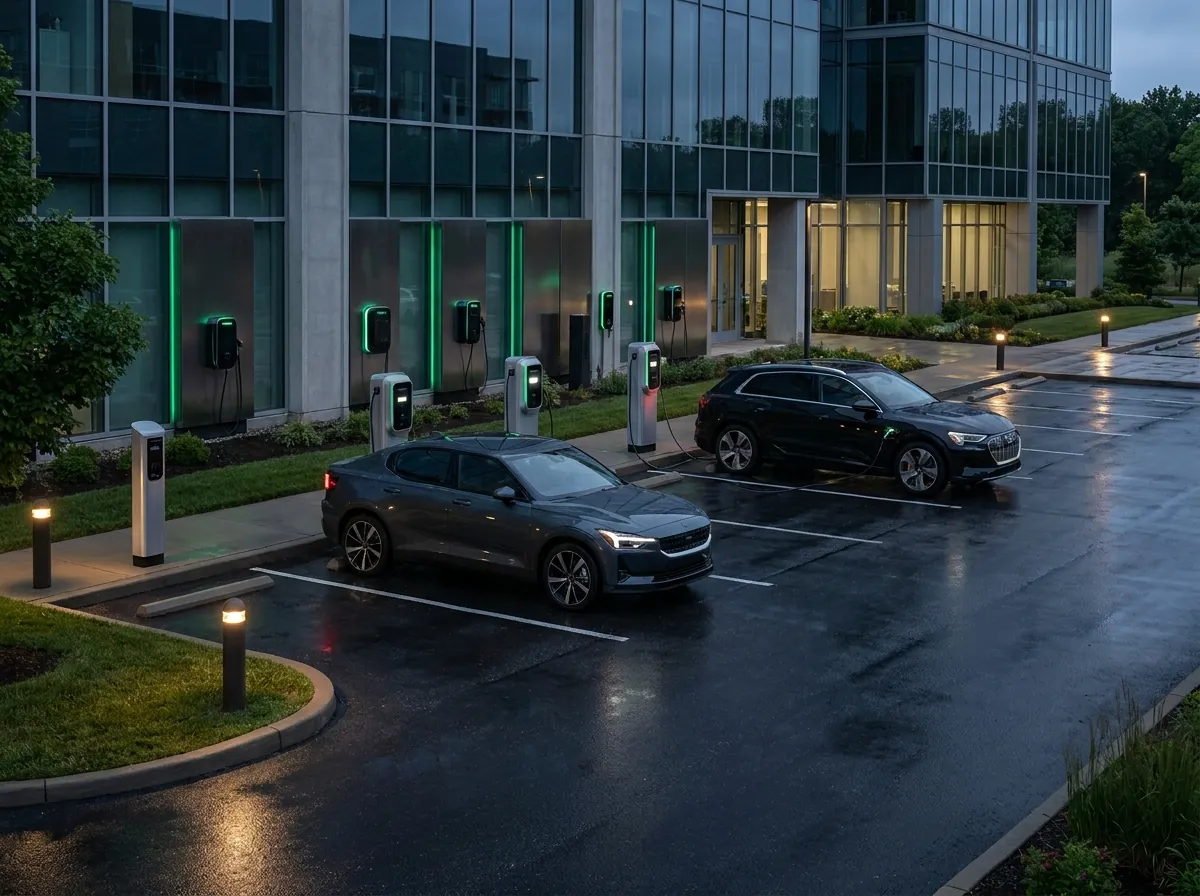
Charge points for staff and visitors, with access control and per-user session logging. Load balancing keeps you within your existing connection.
Fleet and lease
Depot charging that is ready before the first shift. Sessions are logged per vehicle, so reimbursement and lease settlement are straightforward.
Multi-site rollout
One specification, one contact and one invoice across locations, so each site does not end up with different hardware and a different back office.
Where business projects go wrong
The most common mistake is ordering hardware first. Chargers arrive, the electrician discovers the connection cannot carry them, and the project stops for six months waiting on the grid operator. Measuring capacity costs an afternoon and prevents exactly that.
The second is buying charge points without deciding how electricity gets settled. Retrofitting authentication onto installed hardware usually means replacing it.
Business charging
Yes. Chargers with an RFID reader or an app log every session per user, and the back office turns that into a monthly statement. This is what most companies actually need: not a payment terminal, but a reliable record of who charged how much, so it can be settled through payroll or invoiced to a lease company.
A public charger with card payment is a different product, with payment terminal certification and transaction fees, and it rarely makes sense on private company grounds. For staff and visitors, access control plus session logging is cheaper, simpler and does the same job. We will tell you which of the two your situation calls for, and it is usually the second.
Fewer than most people expect, and this is where projects go wrong. A standard three-phase business connection runs out quickly once several cars charge at 11 kW at the same time. Load balancing spreads the available capacity across the charge points dynamically, which often means you can triple the number of charge points without touching the grid connection. We measure before we quote.
The SPRILA scheme covers EUR 800 per 11 kW AC charge point for SMEs and EUR 400 for large companies, with a minimum of EUR 2,500 per location. It requires registration with the Dutch Chamber of Commerce. Whether an application is granted is up to the issuing body, not up to us, so we never build it into the business case as a certainty.
Yes, across the Netherlands. Around Zwanenburg, between Haarlem and Amsterdam, and everywhere else, the work is carried out by our fixed installation partner, with certified engineers across the Netherlands, to the same standards. Multi-site rollouts are coordinated from one point of contact.
A charge point that is down is a car that cannot leave. Most faults turn out to be settings or connectivity rather than hardware, and if the charger is online, many faults can be resolved remotely through its management portal. If that does not work, the installer comes out for the repair.
Start with the capacity, not the catalogue
Tell us how many cars and we will tell you what your connection can carry, before you order anything.